The Company: The Rise and Fall of the Hudson's Bay Empire by Stephen R. Bown
Copyright : 2020
Pages:486
Book Read This Year: 4th
I learned a lot about The Hudson's Bay Company and the geography of northern North America from this book.
Bown covers from The Hudson's Bay Company's inception in 1670 when French traders, Radisson and Groseilliers, rebuffed by their county of nativity went to England to find investors, all the way to the dissolution of the government protections when The Hudson's Bay Company became a regular private business in 1870. Many interesting figures pepper the pages from the native wonder woman Thanadulther, to the visionary Alexander Mackenzie, to the ethically grounded David Thompson, to the overly optimistic Lord Selkirk, to the uniquely cultured Métis people, to the twin giants of the west: John McLoughlin and James Douglas. There are many, many others whom I don't have the time or space to mention in detail.
While I found many parts of this book interesting it was on the whole a history book and very dry and hard to read through. It took me three months to work my way through this history. My mind has been enriched, my curiosity satiated, and my interest piqued.
Things I learned......
My favorite sections of the book were about the early days of the Hudson's Bay Company and getting to learn about the different Indian tribes and how the fur trading industry impacted the local and global economy. I was also fascinated to learn some of the technical aspects of trapping beaver and preparing their pelts in the early days. The most valuable beaver pelts to the Europeans were the pelts that had been worn all winter. The Indians wore them fur side towards the body. After a winter of use the guard hairs had mostly worn off. This made the fur perfectly prepared for the felting process in London. A pelt that was ready to felt was called One Made Beaver and was used as a standard of currency.
I learned that John Astor got his start in fur trading. I had not been aware of that before. I am now a little curious to learn more about his humble beginnings and his trajectory over time in the era that he inhabited.
My least favorite part of the book was learning about George Simpson who was in charge of operations for a greater portion of the 1800's. He messed up a lot of things. He changed the way The Hudson's Bay Company conducted business and created a widespread culture of racism. Up to that point the Natives and their way of life had been largely respected. Many, many company men took Indian wives and many, many employees of The Company were of mixed heritage. Under Simpson's reign none of the native wives were recognized and he phased out hiring or promoting anyone of mixed heritage. He had many native mistress who were cruelly discarded even though they and their families had seen the matches as marriages, and he never recognized any of his many illegitimate children. History doesn't look kindly on George Simpson.
I really appreciate the Epilogue that provides a recap of the whole book, which was so helpful. After 3 months of time and more information than I could hold in my brain at once, I really needed that concise refresher. I wish more historical books would do this.
And that concludes my review and thoughts on The Company: The Rise and Fall of the Hudson's Bay Empire.
In this post I want to compile some additional resources that I have been using to continue learning about Roald Amundsen.
This page on Cool Antarctica dot com is all about Roald Amundsen's attempts on the North Pole by air. There are real pictures of Amundsen and Elsworth and the airplanes being constructed. And best of all, there are links to real video footage of the men working on the airplanes and getting things ready for their expedition. I was fascinated by the old silent film recordings.
I have gone on to listen to other series on of the Explorers Podcast. Most recently I enjoyed learning about Hiram Bingham's scientific discovery of the Machu Picchu.
I hope you are finding ways to enrich your mind and continue your education. I like what Lydia over at Home Living blog has to say about "homeschooling yourself." She advocates for coming up with subjects and books to keep your mind engaged throughout your whole life. Never stop learning.
I have been obsessing over Hurdy Gurdy music lately. I recently was reading a book where the Hurdy Gurdy was mentioned. I had always thought that the Hurdy Gurdy was a Grinder Organ. You know, the kind worn on a strap by a street performer with a monkey companion. But, no, while a Grinder Organ and a Hurdy Gurdy both have a crank handle to turn, that is where the similarities end.
I feel as though I have been living under a rock to just be learning accurately about a Hurdy Gurdy at 32 years old. They are fascinating! They sound like several instruments playing together all at once. Here you can hear for yourself:
Lymington Fair
Swipping Maisie
Sussex Cotillion Kesteven Processional Homage to Hearth
Angels We Have Heard On High
It sounds like a blend of Bag Pipes, Violin, and Reeds, with some kind of percussion.
The way they work is by several strings riding up against the wheel that turns by the crank. The wheel is like a round violin bow. There is a box with keys that press against some strings to shorten them and make the different notes. There is also a string that can rattle when the crank is jolted quickly. And there are drone strings that constantly hum.
The Hurdy Gurdy was invented over a thousand years ago and was first used to help people sing in Church before the Organ was a thing.
I am probably out numbered here. I assume you know more about it than I did.
It has been difficult for me to find much Hurdy Gurdy music that I really like. A lot of the Hurdy Gurdy music that I found on YouTube was too heavy for my taste or too middle eastern. That is not the way I want to say that, but I don't know the right words to describe what I talking about. I think by calling what I mean "middle eastern" you will imagine the right tones. It's a high wailing kind of sound that is not exactly minor but has dissonance of some kind.
The videos I have shared here are some of my favorite Hurdy Gurdy songs that I found by hours of combing through videos on YouTube. If you don't like these, try looking up other styles of Hurdy Gurdy music. They are pretty neat instruments!
"Have you not reason then to be ashamed, and to forbear this filthy novelty, so basely
grounded, so foolishly received and so grossly mistaken in the right use thereof? ......
A custom loathsome to the eye, hateful to the nose, harmful to the
brain, dangerous to the lungs, and in the black stinking fume thereof, nearest resembling the
horrible Stygian smoke of the pit that is bottomless."
I recently found a really nice version of King James's Counterblast to Tobacco in a PDF. The spelling has all been updated, and the text is formated in an easy to read way across 9 pages, conveniently in the public domain. There are some latin phrases in the Counterblast. In this version translations to the latin phrases have been given in brackets, which I found very helpful because I don't know latin. Here is a link:
This was a short and entertaining read. I found myself laughing out loud in a few places. King James could be quite hilarious! I found a few sentences challenging and had to read them 5 times to understand the meaning. Some of the sentences are so long that I forgot what the sentence was about by the time I reached the end. I really enjoyed catching on to King James's train of thought. He was way ahead of his time in arguing that smoking tobacco is unhealthy.
Below, I have compiled my analysis of Counterblast to Tobacco. I have distinguished 11 points of argument.
King James's Counter Arguments and excerpts:
Summary of the Introduction: Even good people have a tendency towards corruption and as King he is going to act as physician and diagnose this societal disease of tobacco smoking.
#1. The origins of tobacco use are bad.
"For tobacco being a common herb, which (though under divers names) grows almost everywhere, was first found out by some of the barbarous Indians, to be a preservative, or antidote against the pox*, a filthy disease, whereunto these barbarous people are (as all men know) very much subject, what through the uncleanly and adust constitution of their bodies, and what through the intemperate heat of their climate: so that as from them was first brought into Christendom, that most detestable disease, so from them likewise was brought this use of tobacco, as a stinking and unsavory antidote for so corrupted and a execrable a malady, the stinking suffumigation whereof they yet use against that disease, making so one canker or venom to eat out another.......
.....Why do we not as well imitate them in walking naked as they do? In preferring glasses, feathers, and such toys, to gold and precious stones, as they do? Yea why do we not deny God and adore the devil, as they do?"
#2. People say that all hot and dry things are good for the brain because the brain is cold and moist. King James's counter argument goes like this:
Just because the brain is cold and moist it doesn't proceed that all things hot and dry are a benefit. If the brain is cold and moist, it is because it needs to be for it's good function and smoke is then a detriment.
#3. People say that smoking is good because it helps the body void phlegm. King James's counter argument goes like this:
The smoke doesn't help void phlegm. It causes the phlegm that then must be voided.
"....so this stinking smoke being sucked up by the nose, and imprisoned in the cold and moist brains, is by their cold and wet faculty, turned and cast forth again in watery distillations, and so are you made free and purged of nothing, but that wherewith you willfully burden yourselves: ...."
#4. People say there must be something good about tobacco because so many people find it pleasing. King James's counter argument goes like this:
People are just attracted to novelty.
"And so from hand to hand it spreads, till it be practiced my all, not for any commodity that is in it, but only because it is come to be the fashion. ..... and therefore the general good liking and embracing of this foolish custom, doth but only proceed from that affectation of novelty, and popular error, whereof I have already spoken."
#5. People think tobacco is a cure. King James's counter argument goes like this:
Correlation doesn't equate causation.
"...so if a man chance to recover one of any disease, after he have taken tobacco, that must have the thanks of all. But by the contrary, if a man smoke himself to death with it (and many have done) so then some other disease must bear the blame for that fault. So do old harlots thank their harlotry for their many years, that custom being healthful (say they) ad purgandos renes,["for purifying the loins"] but never have mind how many die of the pox* in the flower of their youth. And so do old drunkards think they prolonged their days, by their swinelike diet, but never remember how many died drowned in drink before they be half old."
#6. People say that tobacco is like a medicine and keeps one in good health. King James's counter argument goes like this:
Medicine can't be taken constantly (as people take tobacco) because it will cause harm if not used appropriately.
"Medicine hath that virtue that it never leaveth a man in that state wherein it findeth him: it makes a sick man whole, but a whole man sick. And as medicine helps nature being taken at times of necessity, so being ever and continually used, it doth but weaken, weary, and wear nature."
#7. Tobacco has addictive qualities.
"In your person having by this continual vile custom brought yourselves to this shameful imbecility that you are not able to ride or walk the journey of a Jew's Sabbath but you must have a reeking coal brought you from the next poor house to kindle your tobacco with? ..... To make a custom in anything that cannot be left again, is most harmful to the people of any land."
#8. Tobacco is a waste of money.
"Now how you are by this custom disabled in your goods, let the gentry of this land bear witness, some of them bestowing three, some four hundred pounds a year upon this precious stink, which I am sure might be bestowed upon many far better uses."
#9. Tobacco smoking is filthy and rude.
"And for the vanities committed in this filthy custom, is it not both great vanity and uncleanness, that at the table, a place of respect, of cleanliness, of modesty, men should not be ashamed, to sit tossing of tobacco pipes, and puffing of the smoke of tobacco one to another, making the filthy smoke and stink thereof to exhale althwart the dishes, and infect the air, when very often, men that abhor it are at their repast?"
#10. Smoking tobacco corrupts one's breath.
"But herein is not only a great vanity but a great contempt of God's good gifts, that the sweetness of man's breath, being a good gift of God, should be willfully corrupted by this stinking smoke, wherein I must confess it has too strong a virtue: and so that which is an ornament of nature, and can neither by any artifice be at the first acquired, once lost, be recovered again, shall be filthily corrupted with an incurable stink, ..."
#11. Tobacco smoking is dishonoring to one's wife.
"Moreover, which is a great iniquity, and against all humanity, the husband shall not be ashamed, to reduce thereby his delicate, wholesome, and clean complexioned wife, to that extremity, that either she must also corrupt her sweet breath therewith, or else resolve to live in a perpetual stinking torment."
Conclusion: [tobacco smoking is] "A custom loathsome to the eye, hateful to the nose, harmful to the brain, dangerous to the lungs, and in the black stinking fume thereof, nearest resembling the horrible Stygian smoke of the pit that is bottomless."
*The use of the word pox can refer to many diseases that cause a rash. I am guessing that this use of the word pox is in reference to syphilis. Syphilis is one of the few diseases that came from the Americas to Europe. This is to the best of my knowledge, but I am not an authority on the subject.
I have made a recording of this Counterblast. I have been unable to find a reading of this work on YouTube. So I made one myself, though it is a little rough around the edges.
I have learned a new wild edible. This is the Nanking Cherry. They are succulent tart little cherries grown on a shrub.
Do you remember this flower that bloomed in March that I saw during my morning walks but didn't know what kind of flowers is was?
Now on my morning walks I see these cherries. I was able to look up the shrub now that it has leaves and berries and make a sure identification.
Nanking Cherries are a drought resistant shrub. I need to get a bunch of these planted in my yard. I think they would make a great hedge. The cherries are tart, delicious, and prolific. All along each branch there are cherries up and down. They would make good pies and jam I think. The trouble would be getting the pits out. They have a miniature cherry pit in each fruit.
I really enjoyed this documentary about nutmeg. I learned many things about the tree and fruit but also about the history of European trade and conquest in the Spice Islands. The second time that watched this documentary my children joined me and I considered it part of homeschooling (even though we watched it on the weekend.) I even drew these coloring pages and made copies for my children to color.
Nutmeg is native to the Banda Islands, which was a closely guarded secret by spice traders for many many years. When the European companies and governments finally figured out where nutmeg was coming from each power tried securing a monopoly on nutmeg. In the end England ceded their Banda Island to Holland as a trade for what Holland called New Amsterdam in America. New Amsterdam's name was changed and today we know it as Manhattan Island of New York!
If you would like to print my coloring pages you should be able to use the links below to access my scanned drawings and print them.
My son had this idea for a funny cartoon depicting the British leaving the Banda Islands to the Dutch saying, "Enjoy your monopoly on nutmeg!" all the while having hundreds of nutmeg seedlings to take and grow elsewhere.
I thought it was such a good idea so I drew it like this:
On April 8, 2024 we witnessed the total solar eclipse. Since that time I have watched video accounts of other people's total solar eclipse experiences.
Each time I watch one of these videos I am brought back, in my mind, to that place of awe and wonder induced by standing in the Moon's shadow.
The awe and wonder of gazing into the black hole where the Sun should be and seeing the ethereal glowing halo of the Sun's corona.
The awe and wonder of feeling so small in God's giant universe.
The awe and wonder that I felt standing in the eerie darkness, yet beautiful light.
And I feel loved, so loved, by God as he displays his greatness in the heavens.
And I think, "The Almighty God cares for tiny, tiny me. He pays attention to me. He takes care of me. He wants fellowship with me. He loves me!"
And the tears roll down my cheeks. It was so beautiful! The eclipse was so beautiful. The fact the God wants to show us this stunning display and has orchestrated it for our viewing is also a thing of beauty.
We had a wonderful eclipse day. We were at a very large park complex in West Frankfort, IL. There were nice playgrounds, mature shade trees, a fishing pond, several baseball diamonds, and some big open fields and a marshy wild life area bordered by woods.
We set up our grill, picnic table, and chairs in a secluded section in the back of the park. We put our tent up, too, just to have a place to relax for some of the children.
The weather was perfect: sunny and 76°F. We played on the playground equipment before the eclipse started. We rushed back over to our camp to witness first contact. It as so exciting. The eclipse was happening! We watched the shadows change. Mr. In the Midwest grilled our pork steaks. We lay on our picnic blanket and observed the Sun shrinking away through our solar filter glasses.
Slowly, slowly the Moon over took the Sun. The Sun looked like a golden cookie that someone had taken a bite out of. Then the Sun looked like a packman. Then the Sun looked like a crescent, then a banana, and then a tiny sliver. When the Sun was down to only about 5% showing the anticipation really became intense. The light was dim and bright at the same time. The air was cooler. The evening birds started to make their calls. A planet appeared.
And then everything went dark. Off came our glasses! We had 4 minutes and 7-8 glorious seconds to witness the beautiful corona and look around at the 360° sunset at the horizon. There were shouts and whistles and laughter. The diamond ring was my favorite part. My two year old didn't care for the Sun going out. He said, "Go home." He meant that he wanted to go home. I held him, pointing to the shimmering ring in the sky and said, "Isn't it pretty?"
And just like that, it was over. The first hair of Sun slipped out and we had to put our solar filter glasses back on.
We ate our lunch and had a happy time watching the Moon edge it's way off of the Sun. It seemed to go a lot faster getting off of the Sun than it had gone covering the Sun.
I am left with overwhelming gratitude. God is so good to me!
I have been loving Camille Saint Saen's The Swan recently. Something about that piece of music really resonates with me. I just can't get enough of it! It is so peaceful and dreamlike.
While learning about this piece of music I found out that The Swan is just one part of Camille Saint Saen's Carnival of the Animals.
I watched a really informative video on YouTube where I learned about each piece included in Carnival of the Animals. The suite is made up of 14 movements:
1. Introduction and March of the Lions
2. Hens and Roosters
3. Wild Donkeys Swift Animals
4. Tortoises
5. The Elephant
6. Kangaroos
7. Aquarium
8. Characters with Long Ears
9. The Cuckoo
10. Aviary
11. Pianists
12. Fossils
13. The Swan
14. Finale
The funny part is that Camille Saint Saen wrote Carnival of the Animals as a joke. It wasn't a serious work, but it became his most famous musical accomplishment. He lived at a time when a lot of musical innovation was happening. Music was rapidly evolving, or, in Camille Saint Saen's opinion rapidly devolving. I have only read briefly about the composer, but the impression I have is that he was a stickler for 'proper,' tried and true, old-fashioned music techniques and theory. You know, the way music was taught when he was a youngster at conservatory. Doesn't every generation say something like that?
Anyway, how ironic that his least serious music became just about the only music that he is remembered by.
I have been listening to Carnival of the Animals on SoundCloud and becoming familiar with each part. My favorite's are The Swan and Fossils. My 8 year old likes Aquarium and March of the Lions the most.
A trick that works for me to be able to listen to music on SoundCloud advertisement free is, that I go to the SoundCloud website in my mobile browser. I don't sign in to any account. I use the search tool to search for specific music that I am looking for, sometimes by title, sometimes by composer. I can play the music in the background or while my phone screen in off. The only trouble is that sometimes the next song that plays automatically is not my choice, and I have to get back on the page and turn it off.
When I am absent mindedly listening to the whole Carnival of the Animals suite and The Swan comes on and I think to myself, "Boy, this music is so nice!" And then I pay attention and I realize, "Oh, this is The Swan, of course, I think it is so nice!" And I chuckle to myself.
Are you familiar with The Swan by Camille Saint Saen? If not, I encourage you to give it a listen and let me know what you think!
Here is the YouTube video that I found to be so informative:
(in case the link doesn't work the title is, "Listener's Guide to Carnival of the Animals by Camille Saint Saen," on the YouTube channel Odd Quartet.)
I have no control over suggested videos or advertising.
What does Art have to do with a good education? I enjoy the arts, but I tend to think of art as a more frivolous pursuit. A luxury for the affluent. I value more highly the subjects that I associate with production; Reading, Math, Science. These subjects have real practical applications. Skills in these areas keep food on the table, they keep people alive.
Art has been added to the STEM education acronym for a while now, making it, STEAM education now. STEAM stands for:
S- science
T- technology
E- engineering
A- art
M- mathematics
I am coming around to seeing the practical value in learning art. This experience shows my progress:
I saw a really nice picture of a chameleon in a board book that I rented from the library for my 2 year old. I really wanted to try my hand at drawing this chameleon, just for fun.
It was fun, but I really had to slow down and pay attention to details. That is a practical skill that art helps to develop. Observation, noticing differences, and minute details are valuable skills. Paying attention to details saves lives!
Art also exercises one's creativity. Creativity also has practical applications. Being creative helps develop new products and come up with solutions for problems.
I made some step by step drawing instructions on how to draw a chameleon for my children.
Easy Version
This is the easy version with obtuse shapes and stick legs.
Step 1. Is draw a rectangle for the body.
Step 2. Add sideways U shape for the head and a tail. Make your tail spiraled or tapered.
Step 3. Add a hood and stick legs. Make elbows/knees point towards one another. Draw the toes forked like an upsidedown letter Y.
Step 4. Draw the face. Chameleon mouths point down, so, give your chameleon a frown. Draw a sawtooth line of points down the back and down the chin/belly.
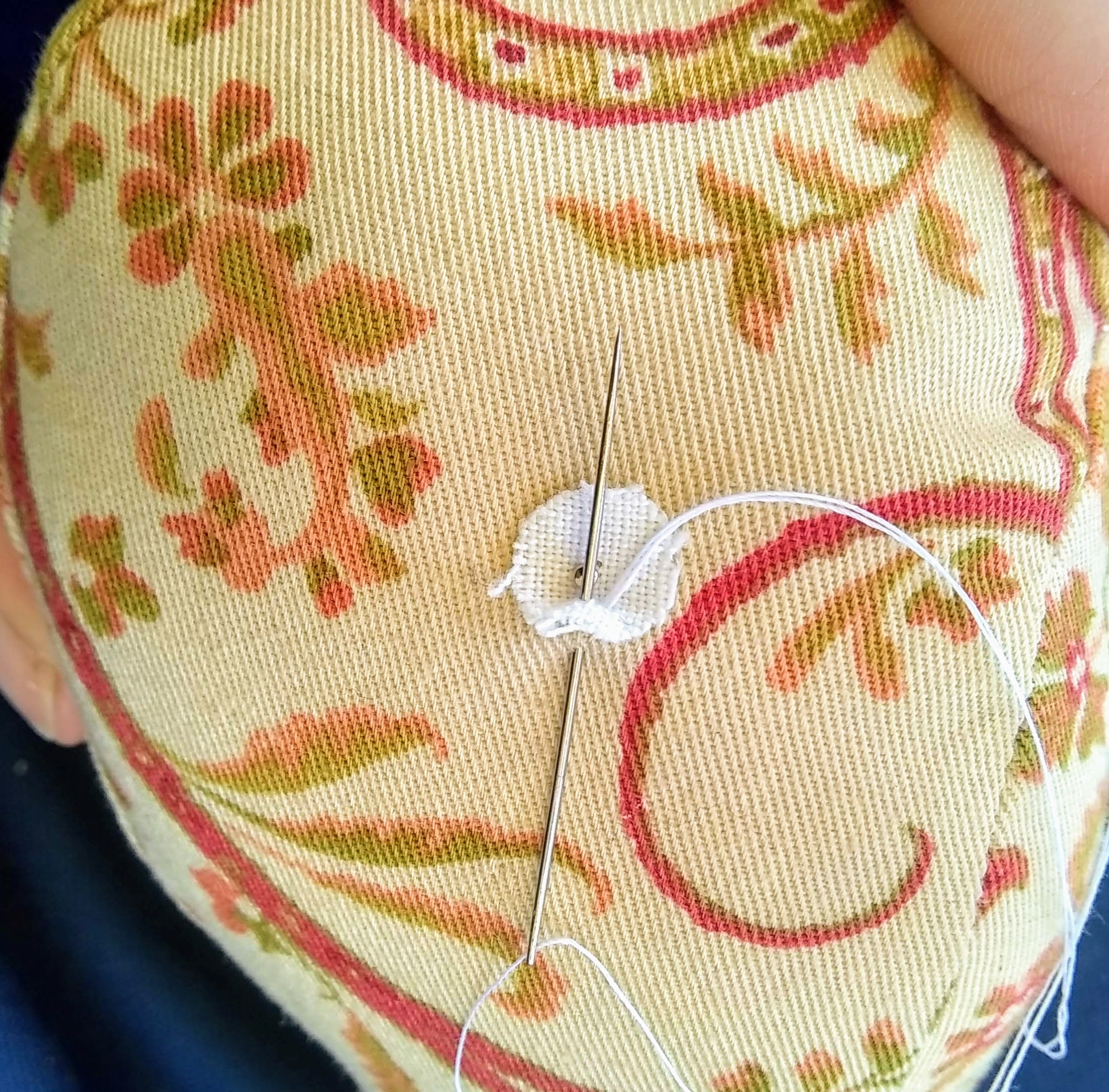
I cut the eyes from a piece of tightly woven, white cotton. I use the back of a pen for a template.
I place the eye on the whale and use a pin to keep it in place.
I thread a needle a tie a secure knot at the end. I poke the needle into the whale a short distance from the eye. I am careful to put the point of the needle between the weft and warp of the weave.
Pull the needle up through the edge of the eye. And pull the knot through to the inside of the whale.
Make a small stitch around the edge of the eye and through the whale fabric.
Pull the stitch down to a small loop.
Using the tip of my needle I lay the stitch just where I want it as I pull the thread tight.
Keep stitching around the edge of the eye.
Go all the way around.
And then stitch all the way around for a second time.
To tie my thread off, I tie a knot in the the thread.
I tie another knot right on top of the first knot.
I poke the tip of my needle, trying to place it between the weave. I have my needle come up a short distance from the eye.
I pull the knot through the hole, and down into the whale.
Clip the thread off.
Next, the pupil of the eye has to be added.
I use a double threaded needle. I tie a knot and pull the knot to the inside of the whale.
I make the pupil with a padded satin stitch. Meaning; I make stitches in one direction and then stitch over top of the first stitches in the opposite direction.
To tie the thread off; I tie a single knot in the thread then poke the tip of my needle down, trying to place it between the weave of the eye fabric and the whale fabric beneath.
I put the needle up some distance away from the eye. I pull the knot through the fabrics. I help the knot go through by pushing down with the tip of my needle while keeping tension on the thread by pulling tightly with my fingers.