Showing posts with label Science. Show all posts

Monday, September 4, 2023

Chameleon Art


What does Art have to do with a good education? I enjoy the arts, but I tend to think of art as a more frivolous pursuit. A luxury for the affluent. I value more highly the subjects that I associate with production; Reading, Math, Science. These subjects have real practical applications. Skills in these areas keep food on the table, they keep people alive. 

Art has been added to the STEM education acronym for a while now, making it, STEAM education now. STEAM stands for: 

S- science
T- technology 
E- engineering
A- art
M- mathematics

I am coming around to seeing the practical value in learning art. This experience shows my progress:
I saw a really nice picture of a chameleon in a board book that I rented from the library for my 2 year old. I really wanted to try my hand at drawing this chameleon, just for fun.

It was fun, but I really had to slow down and pay attention to details. That is a practical skill that art helps to develop. Observation, noticing differences, and minute details are valuable skills. Paying attention to details saves lives! 
Art also exercises one's creativity. Creativity also has practical applications. Being creative helps develop new products and come up with solutions for problems.
I made some step by step drawing instructions on how to draw a chameleon for my children.

Easy Version 

This is the easy version with obtuse shapes and stick legs. 

Step 1. Is draw a rectangle for the body.

Step 2. Add sideways U shape for the head and a tail. Make your tail spiraled or tapered.

Step 3. Add a hood and stick legs. Make elbows/knees point towards one another. Draw the toes forked like an upsidedown letter Y.

Step 4. Draw the face. Chameleon mouths point down, so, give your chameleon a frown. Draw a sawtooth line of points down the back and down the chin/belly.

More Details 


Thursday, February 10, 2022

Creation Close-Up: Spider Silk


Spider Silk is quite remarkable! I am sure everyone here has heard that spider silk is stronger than steel and this is a fact that has been demonstrated by careful experiments. 

But, have you heard that spider silk can be harvested and woven into fabric? 

I recently watched a video highlighting a beautiful tapestry woven from spider silk. This led me to learn more about the history of Spider Silk Harvesting.

Over the centuries many attempts have been made to expedite the harvesting of spider silk. 

Spider silk has antibacterial and coagulant properties. I have read that, as far back as the middle ages, midwives would gather spider webs for medicinal purposes. They collected spider silk in an unsophisticated way by scooping together spider webs from the wild.

But, a cost efficient way of producing spider silk has proved elusive. In the late 1800's Paul Camboué found a way to effectively milk spider silk.

Spiders can produce several types of silk. The type of silk desirable for weaving is known as drag line. It is the type of silk that a spider uses to drop to the ground not to build a web. As long as there is a pull on the line the spider will continue to produce silk.

Video of Spider Silk Harvesting:

Paul Camboué devised a contraption that harnessed a spider and kept it in position.* A strand of silk can then be pulled from the spider's spinnerets and wound onto a spool. A single strand of spider silk can be up to 600 meters** long!

Once enough strands have been collected they can be twisted into thread and woven into fabric.

The kind of spiders that have been most useful in this process have been golden orb weavers on the island of Madagascar. Thier silk is a stunning golden hue. The resulting tapestry is a beautiful golden color without any dye.

Simon Peers and Nicholas Godley have undertaken the project of creating Spider Silk Tapestries. They have produced a few pieces. The latest and most remarkable is a cape that has been displayed in several museums around the world. I can only imagine what this material would feel like to wear. The women that were fortunate enough to model this cape really had a once in a lifetime experience!

How Peers and Godley conducted the making of the Spider Silk Cape:


Isn't this fascinating? I was amazed by this information. I wanted to share it here for your enjoyment, too. Had you heard about spider silk being used in this way before?

Psalms 9:1 
 I will praise thee, O LORD, with my whole heart; I will shew forth all thy marvellous works.

Sources:

Medical Uses of Spider Silk: https://www.materialstoday.com/biomaterials/news/spider-silk-the-future-of-antimicrobial-materials/

*Picture of Camboué's invention: https://daily.jstor.org/the-tangled-history-of-weaving-with-spider-silk/

**https://www.jstor.org/stable/26006154?mag=the-tangled-history-of-weaving-with-spider-silk&seq=1#metadata_info_tab_contents

Tuesday, August 3, 2021

KJV Pew Bible Review|Holman Publishers Vs. Hendrickson Publishers

A couple years ago I came to the conclusion that I would like to use a hardcover pew Bible, as opposed to a leather bound study Bible. The Bible that I use gets beat up. My Bible is part of my everyday, less than pristine, life.

Stitched Signatures
The stitches are visible in the crack above.


Why A Pew Bible?

They are:

• Cheap

• Durable

• Bare Bones Scripture

• Easy to replace

Another thing that made me want to use a pew Bible is that they tend to be plain scripture without commentary and references.

I like this for two reasons:

1. I can come to my own understanding of what the Bible means without as many preconceived notions.

2. The Bible can be fewer pages from Genesis through Revelations. 


I have a Holman Publishers pew Bible that I have used for the past 31 months. It has served me well. It is showing signs of wear and has needed taping in a few areas inside the front and back cover. Mr. In The Mid-west just bought me a new Bible. My new one is from Hendrickson Publishers. I will do a little review and comparison between the two.

Hendrickson Publishers on the Left
Holman Publishers on the Right


Holman Publishers KJV Pew Bible

ISBN #978-1-5864-0942-5

Dimensions:

8"×5.5"×1.25"

Font style and size:


Construction:

Stitched Signatures ✓

Ribbon X


Number of pages from Genesis through Revelations:

1077

Special Features:

Words of Christ in red ✓

Salvation plan ✓

Paragraph delineation symbols ✓

Epistle of dedicatory X

Study helps X

Maps ✓ (2 maps)


Capitol letters and spellings in particular verses:

Gen. 1:2 Capitol S in Spirit ✓

Psalm 51:11 Capitol S in Spirit  X

John 6:63 Capitol S in Spirit  X

2 Tim. 3:17 throughly not thoroughly ✓

1 John 5:7 Capitol F, W, H,+G in Father, Word, and Holy Ghost ✓

1 John 5:8 Capitol S in Spirit  X


Hendrickson Publishers KJV Pew Bible 

ISBN # 978-1-59856-220-0

Dimensions:

8.75"×5.5"×1.125"

Font style and size:


Construction:

Stitched Signatures ✓

Ribbon X


Number of pages from Genesis through Revelations:

740

Special Features:

Words of Christ in red  X

Salvation plan  X

Paragraph delineation symbols ✓

Epistle of dedicatory  ✓

Study helps  ✓ (Key Bible Promises, Harmony of the Gospels, Miracles of the Old Testament, Miracles of the New Testament, Parables of the Old Testament, Old Testament Prophecies of the Passion, and Parables of the New Testament. Only 15 pages total)

Maps ✓ (3 maps)


Capitol letters and spellings in particular verses:

Gen. 1:2 Capitol S in Spirit ✓

Psalm 51:11 Capitol S in Spirit ✓

John 6:63 Capitol S in Spirit  X

1 Tim. 3:17 throughly not thoroughly ✓

1 John 5:7 Capitol F, W, H,+G in Father, Word, and Holy Ghost ✓

1 John 5:8 Capitol S in Spirit ✓

I really like the fact that both Bibles are constructed with stitched signatures. Stitched signatures are much more durable than glued in pages.

I find both fonts and size of the letters easy to read.

The thing that I am most excited about in my new (Hendrickson Publishers) Bible is that it is only 740 pages Genesis through Revelations. 

One feature that I think I will miss is the words of Christ in red that the Holman Publishers Bible features.


Have you considered using a pew Bible for your main Bible? 

Do you want to know any other details about these two Bibles that I compared?

Psalm 119:89

For ever, O LORD, thy word is settled in heaven.

Tuesday, May 18, 2021

Against The Wind / Podcast Recommendation


I am sharing this podcast recommendation here just out of my support for Dr. Paul.

Dr. Paul Thomas is a pediatrician from Oregon and a champion of Informed Consent and Medical Freedom. My children and I have enjoyed watching his Youtube videos for years.

This past December Dr. Paul published data that he had collected in his pediatric practice. The data compared health outcomes between vaccinated children and unvaccinated children.

Read The Study HERE.

The Oregon Medical Board held an emergency meeting and suspended Dr. Paul's medical license. 

Dr. Paul is doing what he can to get his license reinstated.


In the meantime he has thrown his energies into producing this podcast:

Against The Wind: Doctors And Science Under Fire


I have been binge listening to Against The Wind to catch up to the current episode. I have found the interviews very interesting. Dr. Paul has had a diverse group of Doctors and Scientist as guests on his show. The information and the studies that they discuss are being suppressed on the mainstream media outlets. Against The Wind makes it easy to access these unpopular findings and see, not only the benefits, but, also, the risks to pharmaceutical treatments.

The podcast has a lot of relevant information about the illness that is getting a lot of attention in the news right now. The Doctors on the show explain why the fear running rampant is really uncalled for. 

I appreciate Dr. Paul's willingness to acknowledge the risks associated with vaccines, and his boldness to stand up for the data that he found. He published it as he found it. He published it because he thought it would help children and families. He certainly didn't publish the data for his own benefit.

Please go check out his podcast, Against The Wind, if any of these topics interest you!

Of course, I must have a disclaimer that states: I don't endorse all of Dr. Paul's views. In case anyone out there has the unrealistic idea that I can't recommend anything unless I agree with every little thing that a person says or does.

Tuesday, February 16, 2021

Did You Know, Whales Need Fresh Water?


I was surprised to learn that whales can not drink ocean water. What do they do? Drink rain water?

The answer: Whales receive all their hydration through the sea creatures they eat. If they don't eat they will die from thirst before they die from hunger. 


Isn't that a fun little fact? 

I learned it in this video about a Pilot Whale rescue. This story is pretty fascinating! I hope you enjoy watching it, too!

https://youtu.be/wXZio54CSbI


This Pilot Whale became lost close to shore. A research team was sent to investigate. They had to give the whale water because it was severely dehydrated. They tried several times to lead it out to the open ocean, but everytime it came back to the shore area. After some testing the researchers concluded that the whale had a problem with it's sonar system and was unable to locate any prey. Without being able to eat the whale would eventually die. Fortunately, for the whale, Sea World in California was able, and willing to transport the suffering whale to their location. They put this whale on an airplane and flew it to California! Can you believe that? Anyway, that is where the poor Pilot Whale was able to live out his days. He died in 2012.

Genesis 1:21 

 And God created great whales, and every living creature that moveth, which the waters brought forth abundantly, after their kind, and every winged fowl after his kind: and God saw that it was good.

Further reading:

https://www.nature.com/news/whale dies from dehydration

https://blog.seattlepi.com/candacewhiting/2012/05/28/seaworlds-pilot-whale-sully-dies-a-story-of-successful-rescue-and-early-death/

Tuesday, December 8, 2020

Paricutin!

Job 37:5 

God thundereth marvellously with his voice; great things doeth he, which we cannot comprehend.


Less than 80 years ago there lived a farmer in the small village of Paricutin, Mexico. He had a problem area in his field where the earth was dipped down and crops never grew well. He had tried to fill in the soil at that place, but it always sunk down. On February 20, 1943 a crack opened up there and fire-y ash and cinders started spitting out of the ground! A volcano was born! The man and his wife fled the field in fear. They and the people of the village watched that day and through the night as the explosive out bursts of lava and burning particles built a mountain before their very eyes! In the first 24 hours the volcano grew to 50 meters high. At the end of a week there was a 100 meter volcano in Paricutin. What did they name the volcano? Paricutin! 

My five year old son is interested in learning about volcanoes. This is a picture he drew of the Earth with lava flowing to the volcanos on Earth's surface. :)


I was fascinated by this story when I read about it earlier this year in February. I was reading a childrens picture book about volcanoes. One page in the book mentioned Paricutin. It basically said that a farmer noticed a crack in his field in 1943 and now a mountain is there. I was amazed! How could a mountain grow that fast, and so recently, and I never had been told about it? I looked on the internet for information. I found a blog post with a lot of neat pictures and other information about Paricutin. You can read it HERE. (Be warned there is some millions of years garbage on that page, but there are also a lot of links for further reading on the subject.) The pictures are unreal! The mountain looks so out of place that it almost looks fake!

I watched a short, black and white video with some actual footage of Paricutin when it was active.

This is the one I saw:

https://youtu.be/I2r7RTQ6SNk


Paricutin was active for around 10 years. Reaching it's final hight of 425 meters (about 1394 feet) in 1952.

I don't understand very much about plate tectonics. This story has spurred me to learn more on the subject. I am finding it to be very interesting! I am still not sure what circumstances made the Paricutin volcano erupt like it did. I thought it was a really neat story, though, and wanted to tell my readers about it.  

Have you heard about Paricutin before? Are you amazed by the story like I am? I hope you enjoyed reading this post!

Saturday, June 6, 2020

Book Report: Peterson Field Guide to Finding Mammals in North America

Peterson Field Guide to Finding Mammals in North America by Vladimir Dinets is a wealth of knowledge on where to find mammals. I don't know how Mr. Dinets has been able to travel to as many places, and get familiar with the areas, as he has. Mammal Watching is not as much of a hobby as Bird Watching, but Mr. Dinets expects that to change in the future.

This book is broken into several sections. In the first part of the book Mr. Dinets goes through the North American content region by region highlighting what parks and and wildlife refuges are in the areas and what mammals you can find there. Mr. Dinets goes into a lot of detail on where he has seen certain mammals and how likely you are to see the same types of mammals.
In the second section Mr. Dinets goes over each type of mammal and where they can be found. There is a short part on trapping animals for observation. The glossary is extensive.
This book can be used in a multitude of ways. If you are planning a trip, for example, and you want to look up the areas you will be visiting to see what type of mammals live there, you can go to the section that address that particular region. Another example is: if you want to see a specific mammal, you can look up that mammal in the section where that mammal is talked about and you can see a list of locations where that mammal lives.

There are not photographs of every animal that is mentioned, but there are a lot of photographs.

I learned a lot about mammals by reading this book. I had no idea there were so many kinds of whales or bats, or what a Coati was or a Marten was or a Pika was, I could go on. This book has fed my curiosity and left me hungering for more knowledge about mammals. I would really like to read an identification guide for these mammals or something that gives more details on the animals life's and habits.

Genesis 1:25
 And God made the beast of the earth after his kind, and cattle after their kind, and every thing that creepeth upon the earth after his kind: and God saw that it was good.

Tuesday, April 14, 2020

Fun Yeast Experiment!

I conducted a yeast experiment with my boys a few weeks ago. My oldest son is 4 and he loves science experiments. Technically, this wasn't a true science experiment because we didn't set up a control, but oh well, we had fun anyway.


Our experiment was about what types of fuel that bread baking yeast will produce the most carbon dioxide consuming. We had 5 plastic bottles and chose 5 fuel sources; sugar, honey, molasses, corn syrup, and all purpose flour.


Into each plastic bottle we poured 1 tsp. of yeast, 1 TBS. fuel, and 1/4 cup warm water.

We secured a balloon onto the top of each bottle to capture carbon dioxide.

We labeled the bottles as we went.

Within 5 minutes of setting up, the sugar bottle was in the lead.


At the 15 minute mark I noticed that some of the balloons had teeny tiny holes in the stem portion of the balloons. I used rubber bands to seal off the stems.


I took a picture of the bottles after 30 minutes,.....

1/2 hour

... At 1 hour,...

1 hour

... And at 3 hours.

3 hours


The next day I blew up the balloons for the children to play with. We discovered that one of the balloons had a teeny tiny hole on the top of the balloon. I didn't know which bottle it had come off. My first thought was that the holey balloon had been on the bottle with flour. I really had expected the flour balloon to do better than it did.

The next day I ran the experiment again, with a bottle with flour as fuel, and a bottle with sugar to act as a control.


After 4 hours,....

4 hours

There you have it folks, yeast really likes simple carbohydrates.

Bread baking yeast produced about the same amount of carbon dioxide with each of the sweeteners that we tried. There didn't appear to be any significant difference between using sugar, honey, molasses, or corn syrup as fuel. Sugar had a little head start, but after an hour the rest caught up.

Let us know how we could improve this experiment! If you have any ideas tell us in the comment section!

Tuesday, February 18, 2020

Creation Close-Up: Large Blue Butterfly

Maculinea arion


Are butterflies Parasites? Not typically, but in today's post we are going to learn about  a butterfly that requires a relationship with red ants to complete their lifecycle. And, the ants are not the beneficiaries.


The Large Blue butterfly, Maculinea arion, is native in South England, Europe, and parts of Asia. The Large Blue is not a very common butterfly and populations have been declining for quiet some time. It still survives in pockets here and there. Due to its threatened status it has been studied a great deal, and some very interesting things have been discovered about the Large Blue butterfly.

In depth study of the Large Blue goes back to the early 1900's. When entomology hobbyists tried to raise Large Blue butterflies to produce specimens for their display cases. They ran into a troubling problem: the caterpillar always died after the third instar. Why?

Large Blue Caterpillar

Large Blue butterflies live in open fields where the vegetation is short, sheltering in hedge rows and small bushes. Large Blue butterflies lay their eggs on Wild Thyme. Once the caterpillars emerge they eat Wild Thyme blossoms and any other caterpillars that are on the same flower. (Parasites and cannibals!) After the caterpillar reaches the third instar it falls to the ground and waits for red ants to come carry it to their nest. Not any ol' red ants, the Myrmica sabuleti species of red ant. The caterpillar entices the ants to take it back to their nest by secreting a sweet liquid from it's 'honey gland.' Once in the ants nest the Large Blue caterpillar makes it's diet of baby ant larve!  The caterpillar lives in the ant colony for ten months, dining on ant grubs, at which point it makes a crysallis and pupates. The butterfly must crawl out of ant nest to inflate and dry it's new wings.

Isn't that fascinating!


As the twentieth century progressed the Large Blue's population dwindled. It was declared extinct in England in 1979. Some things that diminished the Large Blue's habitat was lack of grazing on pastures and afforestation. With proper management of fields the Large Blue butterfly has been successfully reintroduced in England and there are several healthy populations.

Genesis 1:28  And God blessed them, and God said unto them, Be fruitful, and multiply, and replenish the earth, and subdue it: and have dominion over the fish of the sea, and over the fowl of the air, and over every living thing that moveth upon the earth.

Humans play an important part in the "natural" world. In this tale it was the lack of people raising livestock and allowing these farm animals to graze on pastures that harmed the Eco system for the Large Blue. As well, as planting trees, ironically. Don't get fooled into believing this planet would be a better place without humans on it. God gave us a role of subduing and having dominion over the beast of the field and over the fowl of the air. He made our planet and He knows what is best for it. My point is that we should be raising and domesticating creatures for our own uses.


If you are interested in reading further about the Large Blue butterfly here are the articles that I read and used as sources;
UK Centre For Ecology And Hydrology- The Large Blue Butterfly
Butterfly Conservation-Large Blue 
Wikipedia- Large Blue Butterfly
Entomology Today- The Curious Case Of The Large Blue Butterfly

Tuesday, February 13, 2018

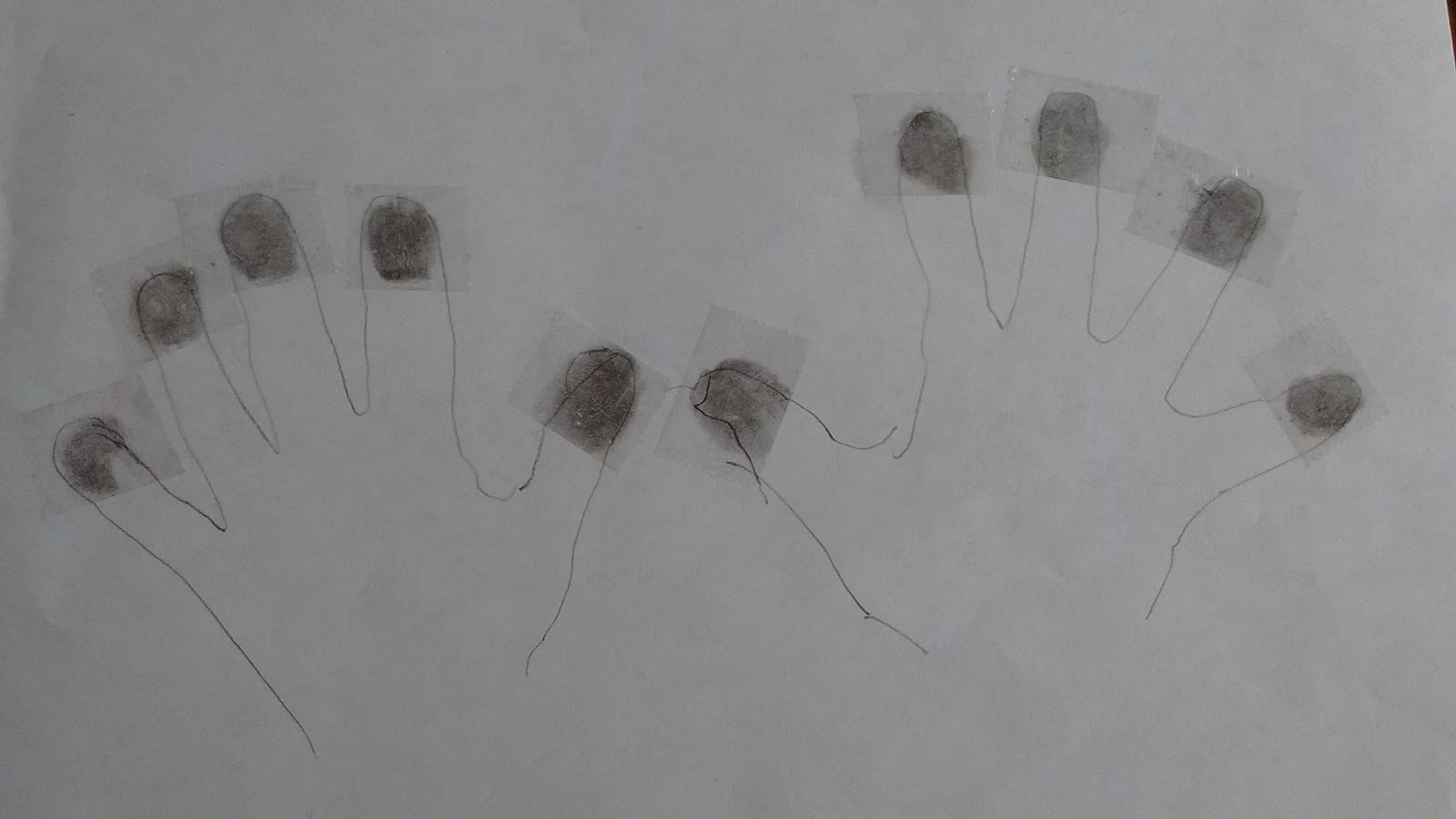
Science Project: Finger Print Cataloging


We all have unique finger prints. This activity is an easy way examine your finger prints.


Supplies:
Graphite pencil
2 sheets of paper
Clear gift wrapping tape

Trace the outline of your hands on to one sheet of paper.


On the second sheet of paper heavily color in a small area with the pencil. Roll a finger tip into the graphite. Try to give your finger pint a good coating.


Press the finger tip onto a small piece of clear tape. The tape will lift the graphite impression of the finger print. Tape the finger print to the corresponding fingertip of the traced hand shapes.


I did this project with BMW last week. I think I was more interested in doing this activity than him, but he did seem to enjoy it. :) He is only 2 and I expected doing this project to be more fun than educational, at this point.

I think it would be fun to catalog your whole family's finger prints and then compare your similarities and differences. Which finger prints did you get from your mom and which ones came from your dad? Of course, you will have your own variations in the designs.


Tuesday, December 26, 2017

Realistic Paper Snowflakes


Snowflakes are six sided water crystals. Most paper snowflakes are four or eight sided.

I found some very thorough instructions for cutting realistic paper snowflakes on this web page Right Here. Please go check it out, if you are interested. There is a lot of good information on snowflakes with many details and some templates.

Here are the basic instructions:

Start with a square piece of paper.


Fold it in half, diagonally.


Fold the triangle in half.


Fold the new triangle into thirds. (This part can be tricky.)


Cut an angle off the top.


Cut your design. The templates from the aforementioned website come in handy here. Tip: don't leave more than 1/4 inch of dead space anywhere in your design.


Unfold to reveal your snowflake!


Wednesday, August 9, 2017

Butterfly Metamorphosis!


We found a caterpillar in my herb bed a couple of weeks ago.


I brought the dill plant, that the caterpillar was on, inside. I put the dill sprig into a quart jar.

It was sticking out of the jar, much like flowers in a vase would. I had a suspicion that this caterpillar was preparing to form it's chrysalis because of how slowly it was moving and how uninterested it was on eating.


Sure enough, with in a day it climbing off of the dill and found a place on my recipe box to form it's chrysalis.


After about two weeks the butterfly was ready to hatch. I noticed the chrysalis had turned a dark color yesterday morning. This made me think that I would be seeing a butterfly before the day was over.


We didn't catch the butterfly coming out of the chrysalis, but when we saw it it was still very floppy and wilted. It took several hours for it to pump it's wings full of fluid and let them dry out.

It was so fun to release the butterfly and watch it use it wings for the first time. It is amazing what a transformation takes place in just a couple of weeks inside a chrysalis!

Genesis 1:25 (KJV) 
And God made the beast of the earth after his kind, and cattle after their kind, and every thing that creepeth upon the earth after his kind: and God saw that it was good.